Spacebar Clicker: Hooda Math, Arealme, Monkeytype, Google Doodle & More: Full Comparison
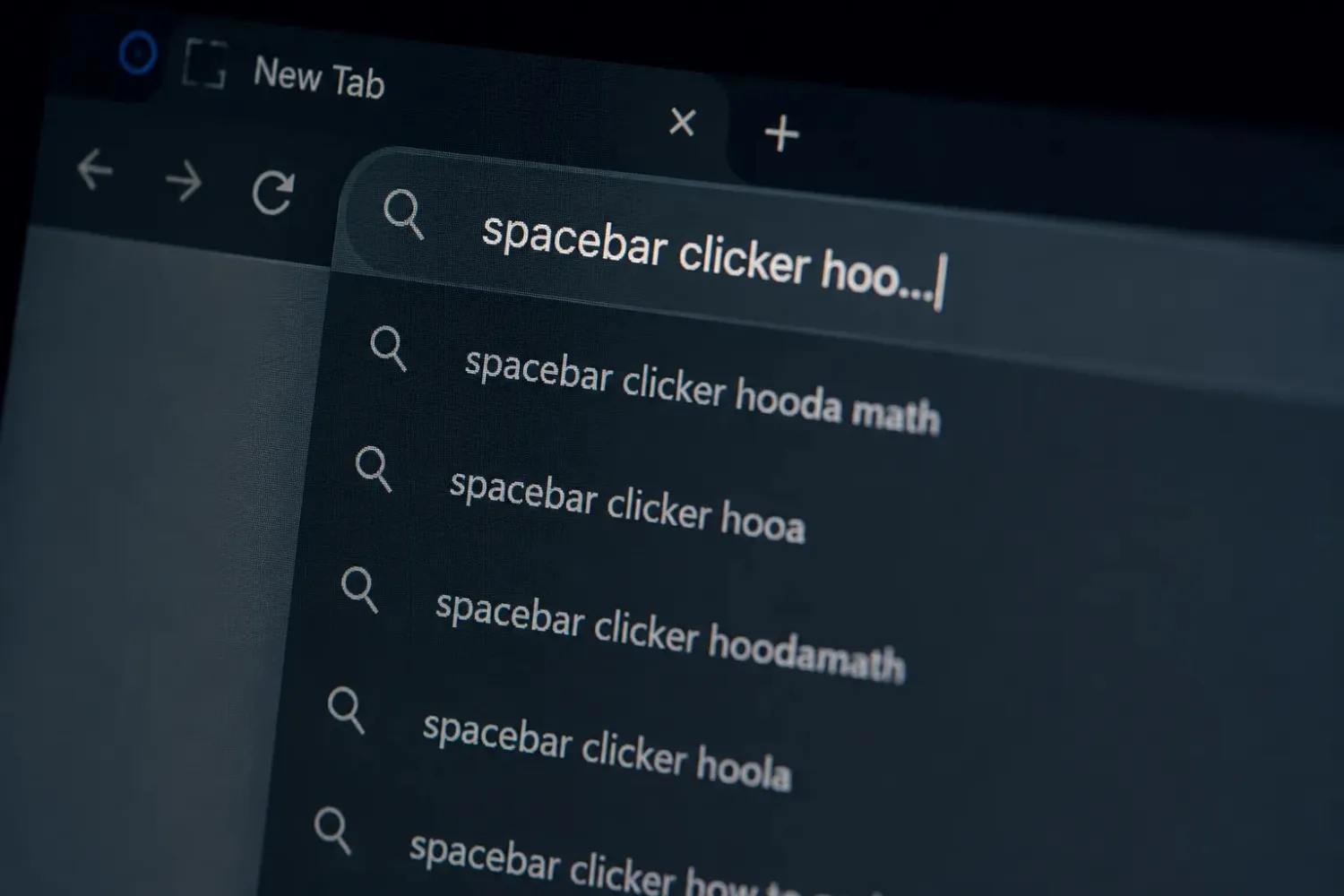
You already know Spacebar Clicker exists. You have probably played it somewhere before, maybe on a school site, through a Google Doodle, or on a typing test platform that happened to have a clicking mode. Now you are trying to find the best version and figure out which one is actually worth using.
That is the search intent behind every variation of this query, 'hooda math spacebar clicker', 'arealme spacebar clicker', 'monkeytype spacebar clicker', and the rest. These are not people discovering the concept for the first time. They are people who have used a version somewhere, want to compare it against others, and are looking for the most complete tool available.
This guide covers each one honestly. What it offers, where it falls short, and when it makes sense to use it.
Why People Search These Brand Names
Spacebar clicker has spread across the internet in fragments. It appeared as a mini-game on Hooda Math because educational game platforms pick up anything with broad student appeal. It showed up on Arealme because that site builds quick browser tests around popular search terms. It arrived on typing test platforms like Monkeytype because spacebar use is central to typing rhythm. And it reached millions of people overnight through a Google Doodle that ran for a single day and then disappeared.
Each of those entry points created a pool of users who remember the experience, associate it with that platform's name, and search for it that way when they want to play again. When someone types 'hoodamath spacebar clicker' into Google, they are almost certainly a student who played it there and wants to find the same thing, or something better, without having to search from scratch.
The honest comparison below covers all of them, including where each tool genuinely serves its audience and where it runs out of features.
Hooda Math Spacebar Clicker
Hooda Math is one of the most widely used educational game sites in US schools. It has been around since 2009 and has built its reputation as a domain that school content filters almost universally allow, because it launched as a maths learning platform, and that label stuck with it through every filter category update since.
The spacebar clicker on Hooda Math is functional. You click, it counts. There is a timer. It gives you a total click number at the end. That covers everything most students need for a quick session between tasks.
Where It Falls Short
The limitations show up quickly for anyone who wants more than basic click counting. There is only one timer mode; you get what you get, no ability to choose a 5-second burst test versus a 60-second endurance run. There is no CPS breakdown. No average CPS, no peak CPS, no consistency percentage. Just a number.
The page runs several ad units alongside the game, which means it loads more slowly and the layout feels cluttered. There is no leaderboard. No achievements. No upgrade system. It is a click counter with a timer, and nothing more.
The reason students keep returning is simple: it loads on their school Chromebook without a problem. That accessibility drives the search volume. The tool itself is not what keeps people coming back.
Arealme Spacebar Clicker
Arealme is a quiz and speed test site that produces short, browser-based tools around popular search terms. Their spacebar test page is well-known in the CPS community because it was one of the earlier clean-looking tools available without heavy ad clutter.
What It Measures and What It Misses
Arealme shows you a CPS number, which already puts it ahead of Hooda Math. The interface is cleaner, and the result displays clearly. It runs one timer mode, typically 5 or 10 seconds, depending on the version, and shows your CPS at the end.
What it does not offer: multiple timer modes, a consistency metric, leaderboard submission, any form of progression, or upgrades. It is a single-session measurement tool. You get your number, and that is the end of the interaction.
For someone who wants a quick, clean CPS number with no sign-up required, Arealme does the job. For anyone who wants to track improvement over time, compare against other players, or work through an upgrade system, it has nothing to offer beyond that first result.
The search terms 'arealme spacebar clicker' and 'spacebar clicker arealme' represent users who have already used the tool and are returning to it, or looking for something that does more. If you want to test across all four timer modes and get a full score breakdown, the spacebar click speed test covers average CPS, peak CPS, and consistency in one session.
Monkeytype: This One Is Different
Monkeytype deserves its own explanation because it is not a spacebar clicker at all. It is one of the best typing speed test tools available online, with a clean interface, no ads, highly configurable, and genuinely respected in the typing community. But it does not measure spacebar click speed.
What Monkeytype Actually Tests
On Monkeytype, the spacebar is used as a word separator during typing tests. Every time you finish a word, you press the spacebar to move to the next one. The platform measures your words per minute and accuracy, not how many times you can press a single key.
This is why people searching for 'monkeytype spacebar clicker' or 'spacebar clicker monkey type' usually end up confused. They expect a clicking test and find a typing test instead. The two tools measure completely different things.
Monkeytype is an excellent tool for what it does. If you want to improve typing speed, it is one of the best options available. According to its own documentation, it supports over 30 languages and multiple test modes. But if you want to test how fast you can press the spacebar repeatedly, which is a different physical skill, Monkeytype is the wrong tool for that purpose.
The distinction matters practically. A 12 WPM typist and a 12 CPS spacebar clicker are doing completely different things with their fingers, under different levels of sustained effort, using different techniques. Confusing the two tools gives you a number that means something other than what you thought it measured.
JS13kGames: Where It Started
JS13kGames is an annual JavaScript game development competition where developers build games in under 13 kilobytes of code. The constraint produces stripped-down, browser-native games, and a spacebar clicker fits perfectly within those limits.
The spacebar clicker that appeared in JS13kGames competitions was not intended to be a long-term product. It was a competition entry. That context matters when you try to use it for serious CPS testing.
Why People Still Search for It
The JS13kGames community is active and vocal. Competition entries get shared widely, discussed in developer forums, and referenced in gaming threads. Some of those entries become well-known enough that players seek them out directly, even years after the competition ends.
Searching 'spacebar clicker js13kgames' usually reflects someone from a developer or gaming community who encountered a specific competition entry and wants to find it again. The versions that circulate are technically simple; they measure clicks, they run in the browser, and they work without any dependencies. They are also frozen in time, because competition entries do not get updated.
The gap between a JS13kGames competition entry and a full-featured tool is essentially the entire upgrade system, leaderboard, multi-mode timer, and score tracking. The competition entry proves the concept. A developed tool is what you build afterwards.
Google Doodle Spacebar Clicker: The Full Story
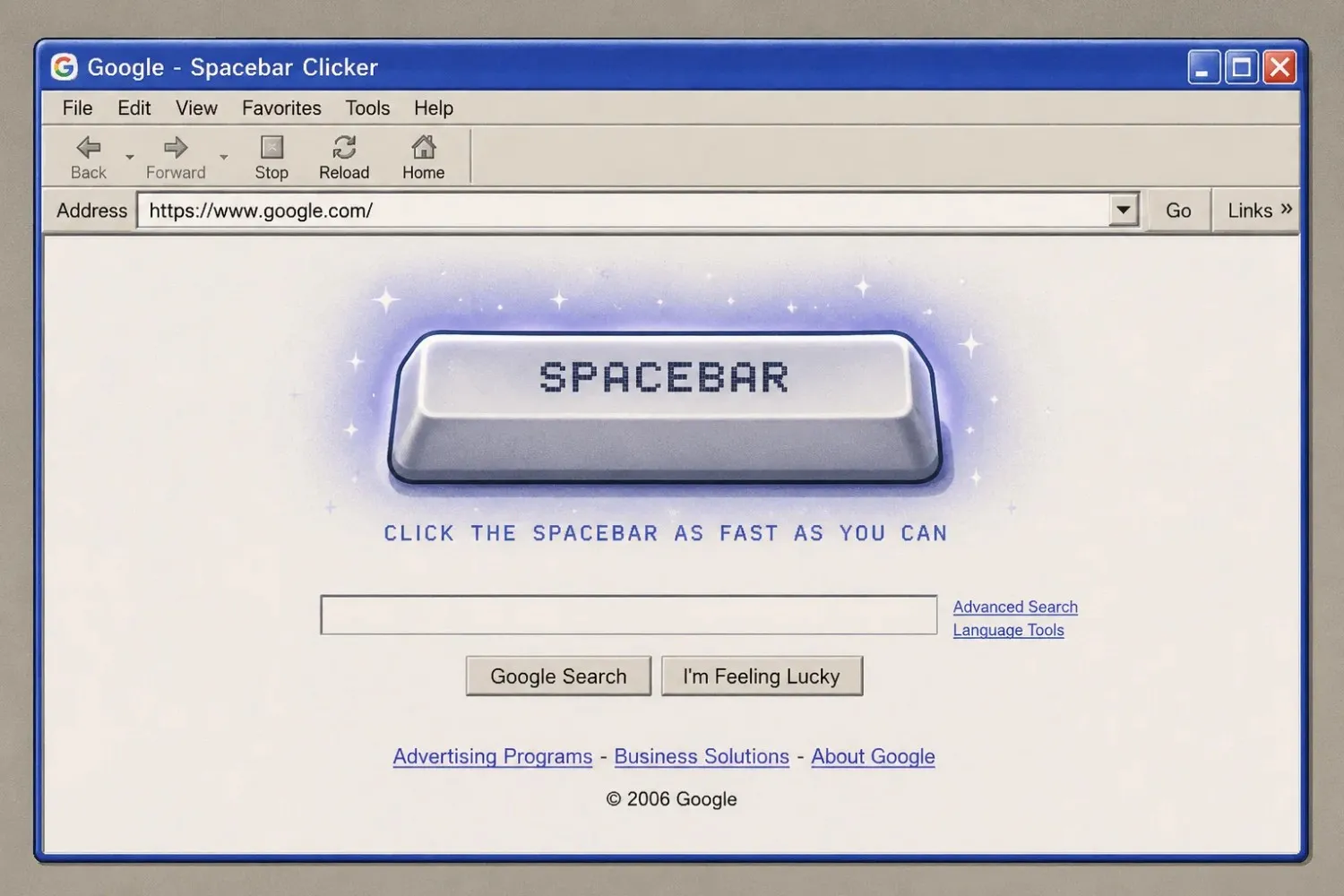
Google Doodles are interactive experiences that replace the Google logo on the homepage for a single day, usually tied to a date or anniversary. They have ranged from simple illustrations to fully playable browser games, and some of them became genuinely viral.
The spacebar-focused Google Doodle introduced a huge number of people to the concept of measuring their pressing speed as a game mechanic. For a single day, millions of people who had never thought about CPS opened Google, saw the interactive Doodle, and started clicking. Many of them wanted to find the same experience again afterwards, which explains why 'Google Doodle Spacebar Clicker' still generates consistent search volume years later.
It Is No Longer Available
Google Doodles do not stay live permanently. After the featured day ends, they move into Google's official Doodle archive, where they can be viewed and, in many cases, replayed. However, interactive Doodles in the archive do not always function the same way they did when live, and the search experience that brought millions of people to the spacebar mechanic, accidentally discovering it on the Google homepage, does not repeat.
Searches like 'Google spacebar clicker' and 'Google doodles spacebar clicker' come from people trying to find what they experienced during that original Doodle day. They are not looking for a Google product. They are looking for a clicking game that works in the browser right now, with real features, that they can come back to.
According to the archive records, interactive Doodles have been a feature since 2010, and some of the most replayed ones involve timing and reaction mechanics, which is consistent with why a spacebar-based Doodle generated lasting search interest rather than a one-day spike.
Side-by-Side Comparison
Here is how each tool stacks up across the features that actually matter for someone who wants to measure and improve their clicking speed.
| Tool | Timer Modes | CPS Tracking | Leaderboard | Mobile | School-Safe | Free | Upgrades |
|---|---|---|---|---|---|---|---|
| Spacebar Clicker | 5s, 10s, 30s, 60s + custom | Yes, avg, peak, consistency | Yes, global + Top 500 | Yes | Yes | Yes | 20+ |
| Hooda Math | 1 mode only | Basic click count | No | Limited | Yes, edu domain | Yes | No |
| Arealme | 1 mode only | Basic CPS only | No | Yes | Yes | Yes | No |
| Monkeytype | Typing modes | Typing WPM, not click CPS | Yes, typing only | Yes | Yes | Yes | No |
| JS13kGames | Varies by version | Basic | No | Varies | Sometimes | Yes | No |
| Google Doodle | No timer | No CPS tracking | No | N/A | N/A | N/A (gone) | No |
A few things stand out from this table. Hooda Math and Arealme both pass on the school-safe front, which is why they get so much traffic from students, but neither offers anything beyond a basic click count. Monkeytype does have a leaderboard, but it is for typing speed, not clicking. JS13kGames versions vary by entry. The Google Doodle is gone entirely.
Which One to Use and When
The right tool depends on what you actually need from it. Here is a practical breakdown.
Use Hooda Math If School Filters Are the Priority
If your school network specifically allows Hooda Math by domain and blocks everything else, it is your most reliable option for getting through a filter. The game works. It counts clicks. That is what it offers, and for a school break, it is enough.
Use Arealme for a Quick, Clean CPS Number
Arealme gives you a CPS result with less visual clutter than most sites. If you want a fast read on your speed without any progression system, it does that well. Just do not expect to track improvement over sessions or compare against others.
Use Monkeytype for Typing Speed, Not Clicking
Monkeytype is excellent at what it measures. If your goal is words per minute, accuracy, and typing consistency, it is one of the most polished tools available. But if you want to know how fast you can press the spacebar as a standalone action, without it being part of typing words, Monkeytype is the wrong tool.
Use This Site for CPS Tracking, Leaderboards, and Progression
If you want four timer modes, a consistency score, peak CPS tracking, a global leaderboard, achievements, and an upgrade system, this is the tool built around all of that. The spacebar clicker game runs entirely in the browser, works on Chromebooks and school networks, and has a built-in auto clicker for calibration. Every feature is free with no account required.
The honest version of this recommendation: use whatever version is accessible and useful for what you need. Hooda Math works at school. Arealme gives a clean number fast. But if you are returning repeatedly to track improvement or want your score to mean something against other players, the comparison table above shows where the gap is.
Conclusion
Every tool on this list has a reason people use it. Hooda Math gets school traffic because filters let it through. Arealme gives a clean result fast. Monkeytype is excellent for typing, just not for clicking. JS13kGames versions are interesting historical artefacts of the game jam world. The Google Doodle introduced millions to spacebar clicking in a single day, then disappeared.
What they all share is a gap somewhere. One timer mode, no leaderboard, no progression, no CPS breakdown, or simply no longer available. Knowing which gap matters to you makes the choice straightforward.
Frequently Asked Questions
Is the Hooda Math spacebar clicker the same game?
Not exactly. Hooda Math hosts a version of the spacebar clicker concept, but it is a stripped-down implementation with one timer mode and no CPS breakdown. It measures total clicks, not clicks per second, in any meaningful detail.
Does Monkeytype have a spacebar clicker mode?
No. Monkeytype uses the spacebar as a word separator in typing tests. It measures typing speed in words per minute, not how many times you can press the spacebar in isolation. They are different tools measuring different skills.
Can I still play the Google Doodle spacebar clicker?
The original Google Doodle ran for one day and is no longer available in its original form. The Google Doodles archive at google.com/doodles preserves many interactive Doodles, but the experience of discovering them live on the Google homepage does not repeat.
What is the best spacebar clicker for school?
Hooda Math loads through most school content filters because of its educational domain classification. This site also passes most filters because it runs on clean HTML with no third-party ad scripts that commonly trigger category blocks. Whether either one loads on a specific network depends on how that school's filter is configured.
What is JS13kGames, and why is Spacebar Clicker on it?
JS13kGames is an annual game development competition where developers build browser games in under 13 kilobytes of code. A spacebar clicker is a natural fit for that constraint. Competition entries get shared in developer communities, which is why searches for that version still appear years after the competition.
Does Arealme show your CPS score?
Yes. Arealme shows a clicks per second figure at the end of the test. It is a single number without breakdown into average CPS, peak CPS, or consistency. For a quick reference, it works. For tracking improvement over time, it has no history or leaderboard.
Try the most complete version
Four timer modes, full score breakdown, leaderboard, and a built-in auto clicker — all free.
Play Spacebar Clicker